A Level English Language: Summer Work for Incoming Year 13

Studying A Level Language in Year 13 next year? Here’s your summer transition work:

1. Make sure you have a copy of the AQA English Language Student Book and the Revision Workbook.

We will be making regular use of both in class next year.

The texbook is available on Amazon here, and the workbook is here.

2Watch the debate you’ll find on YouTube below. 

When you’ve watched the debate, answer the following question in the comments on this post:

Is the English language ‘going to the dogs’?

You should aim to write between 200 and 300 words, and refer to ideas presented by the speakers in the debate.

________________________________________________________

And that’s that!

If you’ve any questions over the summer, email Mr Parry-Shovlin (s.parry-shovlin@lutterworthcollege.com).

Enjoy the holiday!

A Level English Language: Summer Work for Incoming Year 12

Right then, incoming Year 12s doing English Language A Level: here’s your summer work!

All of the tasks below must be completed in advance of your first Language lesson next term.

1. Make sure you have a copy of the AQA English Language Student Book and the Revision Workbook.

We will be making regular use of both in class next year, and you will be expected to bring them with you to every lesson.

The texbook is available on Amazon here, and the workbook is here.

2. Create a ‘language scrapbook’.

This scrapbook will form an integral part of your first term’s worth of lessons, and needs to contain the following items:

(Note: for electronic texts, you’ll need to screenshot and print them.)

  • A text message/WhatsApp interaction
  • An interaction on Facebook (e.g. a status and some replies to it)
  • An interaction on Twitter (e.g. a tweet and some replies)
  • A printed advertisement
  • An online advertisement
  • A poster
  • A menu
  • A film review
  • A newspaper comment piece (e.g. from The Guardian’s Comment is Free section)
  • A speech
  • A piece of unsolicited post (‘junk mail’)

3. Have a look at this blog post and respond to it in the comments section.

Your comment should be around 200-300 words. Make sure you watch both videos before responding. You might also want to read through the comments that are already on the post. (Avoid anonymous comments.)

4. Make detailed notes on the Nouns section of the Grammar Glossary.

We’ll be having a little test on this when you return, so make sure your notes are up to scratch!

And that’s that!

If you have any questions about any of the tasks above, or the course in general, contact Mr Parry-Shovlin (s.shovlin@lutterworthcollege.com).

Enjoy the hols!

A Level English Literature: Summer Work for Incoming Year 12

Read Text Slowly Before and After Class

Incoming Year 12s studying English Literature next year: here is your transition work.

If you have any questions about any of the work detailed here, please contact the A Level English Literature Coordinator, Mr Smith (m.smith@lutterworthcollege.com).

Summer Reading

You need to read Othello by William Shakespeare and The Great Gatsby by F Scott Fitzgerald.

You can get hold of the appropriate editions of each text at the links below. (To save money, you could buy a second-hand copy.)

Othello – William Shakespeare

The Great Gatsby – F Scott Fitzgerald

You must bring these books with you when you start back after the holiday. We’d also like you to make a bulletpointed synopsis of both of these texts.

Research Tasks

1. Read the interview with Terry Eagleton and answer the following questions in detail.

Terry Eagleton Interview – Asking Important Questions

(a) What, according to Eagleton, is the role of literary theory when analysing texts?

(b) What does Eagleton believe makes a good English student?

2. Read this article from the British Library and then summarise, in your own words, what makes a Shakespearean tragedy.

3. Read the article from emagazine below, and then write half a page in response to the following statement: ‘Simon Bubb argues that Iago’s lack of humanity is what Shakespeare is most interested in sharing.’ To what extent do you agree?

eMag – on Iago

4. Read the task sheet titled The Canon (link below). For each of the authors listed, write the title of at least one of their works and the genre.

The Canon

Remember that you must bring evidence of all tasks having been completed to your first English Literature lesson next term. If you have any questions, please email me on m.smith@lutterworthcollege.com

Enjoy the summer!

Mr Smith

Revising for GCSE English Language: Our Top Tips

On Tuesday 7th June, you’ll be taking your two English Language exams back-to-back. Together, they account for 60% of the overall GCSE grade. Here are our top tips for preparing for the papers. With a little luck, you’ll know most of this already!

1. Know what to expect! We cannot stress this enough. You should know exactly what your papers will look like, what kinds of question you’ll be asked, and how long you should be spending on each task. You can find all of the past papers here, and our 8-page revision guide gives you everything you need to know about timing and approaches to each question.


2. Make use of ActiveTeachIt’s packed with guidance on both the Unit 1 (Reading) and Unit 2 (Writing) papers. You can access it here, where you’ll also find a guide as to how to find what you need.

3. Have a look at the exemplar student work we’ve uploaded to the blog. You’ll find A* examples of all seven different types of writing you could be asked to produce for the Unit 2 paper – as well as some top grade mock exam responses.

1

4. Read the examiners’ reports we put together for you after each mock exam. We’ve pointed out the most common mistakes students made so that you can avoid making them yourselves!

5. Have a go at some of our tests designed to improve the accuracy of your writing. You’ll be emailed your scores a few minutes after you submit your answers.

6. Read, read, read! We’ve put together a list of ‘Quick Reads’ for you – texts that can all be read in around 5 minutes – that’ll help you to practise your reading skills, and they might give you ideas for your writing tasks too. The best writers are the ones who’ve read widely. Be one of them!

And that’s it,  Year 11.

Good luck. We have total confidence in you!


Year 10: Writing with a viewpoint assessment

Right then, Year 10!

In your English lessons after half term, you’ll be completing a 45-minute exam-style assessment in which you give your point of view on a contentious statement.

The statement will be provocative – something designed to get you thinking – and you’ll be asked to write one of the following types of text:

– A formal letter

– A speech

– An article

While we can’t tell you the specific task you’ll be completing – as that would be cheating, of course – we will tell you that the topic will be social networks like Facebook, Twitter, Instagram and Snapchat.

Over half term, we recommend completing the following tasks to ensure you are fully prepared for the assessment:

– Read the section on Writing with a viewpoint in your My Revision Notes study guides. (You can buy these from the library; details here.)

– Read and make notes on this presentation.

– Watch this TED talk in which Sherry Turkle looks at the downsides of social media.

– Read this article from the BBC which explores the positives and negatives of social networking.

Have a think about your own views on social networks. Do you you think they bring us together, or push us apart?

Remember: your piece of writing will be marked out of 40, with 24 marks for AO5 (content) and 16 marks for AO6 (accuracy). To that end, you might find it useful to complete some of the sections on Using effective punctuation and Improving sentences and grammar in your My Revision Notes books.

Any questions? See your English teacher.

Good luck!

My Revision Notes – Writing with a Viewpoint

Want to get involved in the Lutterworth College student magazine?

‘What student magazine?’ we hear you ask. Good question – as there isn’t one yet! And that’s why we need your help.

We’re looking for enthusiastic students in all year groups who’d like to get involved in a monthly student magazine, which we’re hoping to launch in September.

We’ll be needing students to edit the magazine, write for it, design it, edit it, take photos for it – so if you have a talent in any of those areas, let us know by completing this form.

We’ll be in touch by the end of the month to arrange our first meeting.

Any questions? Speak to Mr Shovlin or Mr Ford.


Revising Of Mice and Men? Want to win big?

FullSizeRender (2)

Want to get your hands on three whole packs of Oreos – as modelled by our very own Mrs Dalby?

You’ve got to be in it to win it!

Step 1

Download the free Quizlet app for your phone here.

Step 2

Create an account on it.

Step 3

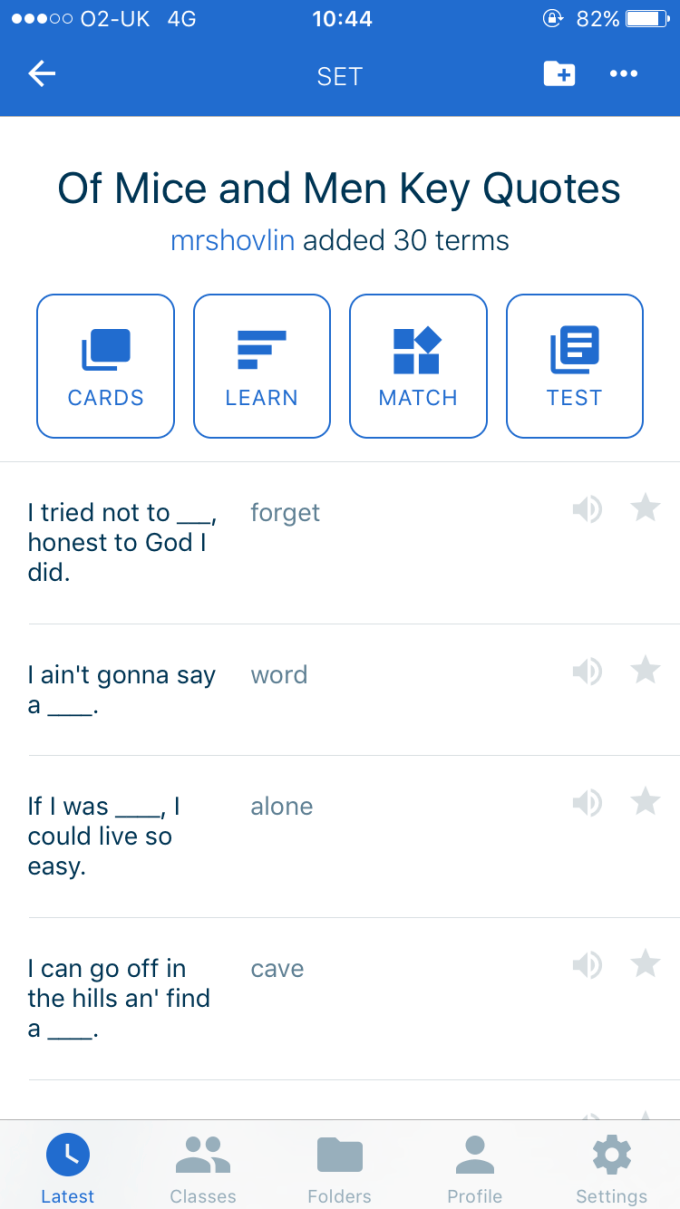
Import this set of flashcards on Of Mice and Men.

Step 4

Play the game titled Match.

IMG_1306


Step 5

Screenshot your best time and send it to us on Twitter (@englishatlc) or by email (s.shovlin@lc.leics.sch.uk).

The student with the best time at 3pm on Wednesday 18th May will receive all three packs of Oreos. #nomnomnom etc.

Good luck!


Revising for GCSE English Literature: Our Top Tips

Your English Literature exams take place on Monday 23rd and Friday 27th May. Together, they account for 75% of the overall GCSE grade for that subject. Here are our top tips for preparing for them…

1. Know what to expect in your exams. You can find all of the past papers by clicking here. Familiarise yourself with how the papers look, and where the texts you’ve studied can be found in them. (Don’t be one of the students who tries to answer on books they haven’t even read!) Our revision guide is a quick-and-simple way to find out what to expect from both exams.

2. Re-read the books/play you’ve studied. You’ll be amazed how better you understand a text when you read it a second/third time.

3. Download some of our revision audio files for use on-the-go. (For the password, ask your English teacher or email Mr Shovlin – s.shovlin@lc.leics.sch.uk – who’ll send it to you.)

4. Explore our revision folders where you’ll find a ton of useful revision material. The Of Mice and Men folder, for instance, contains a 20-minute version of the book, extracts from some revision guides, and lots of exemplar essays on it.

CGP

5. Use the revision guides you’ve boughtEvery year,several students splash out on revision guides but don’t ever bother to use them. Don’t be one of them. The guides are often written by examiners, and so are tailored to the kinds of thing you need to know.(Many of the revision guides you need are still on sale in the library at discounted prices – why not treat yourself?)

6. Learn the key quotes from the texts you’ve studied, as you won’t be allowed copies of them in the exam. The best thing to do is compile your own sets as you’re more likely to remember them – but to give you an idea of what you could do, have a look at our set of Of Mice and Men key quote flashcards – here’s the set, which you can play with online, or import into the free Quizlet app on your phone. Why not have a go at making your own for the other set texts you’ve studied?

7. Re-read our examiners’ report on the Literature mock exam. You can then avoid the common pitfalls in the real thing. You can read some A* exemplar papers here if you want to see the work of some students who excelled that that mock.

8. Download the BBC Bitesize app and set it up for the set texts you’ve studied (and for any other subjects you’re taking.) It’s free and it’s written by senior examiners, and so you know it contains good advice.


We hope these tips are helpful.

Good luck for the exams – we have faith in you!

And don’t forget to check back on the blog for our Language exam tips which will be up over half term.


Year 11 English Literature Mock Exam Examiners’ Report

Right then, Year 11.

Your Literature mock exams have now been marked, and you’ll be getting the papers back at some point over the next few days.

Your teachers have put together the following examiners’ report to help you to identify ways in which you could improve in advance of the real things – which aren’t too far away now!

Don’t forget we’ve also uploaded a couple of A* exemplar papers to give you an idea of what gets the highest marks. You can find these here, where you’ll also find the mock exam paper and mark scheme.

Overall messages

  • Timing seems to be the big problem – with a number of you not dividing your time appropriately in the exam. Remember: an extract question is worth 10 marks, whereas a longer-writing task is worth 20 marks. Because of this, you should be spending no more than 20 minutes on an extract analysis, leaving you with 40 minutes for the essay.
  • You need to know the texts inside out so that you are fully prepared for the questions that will appear on the exam paper. There’s no substitute for re-reading the books and plays you’ve studied. It’s amazing how much more you can get from a text on the second and third readings of it.

Extract analysis

  • Across the year, this achieved the highest average mark. The best responses followed the guidance on page 3 of our Literature revision guide and began with a brief overview of where the extract is from in the novel, with an overview of what the reader learns about Crooks.
  • The strongest answers tracked the text carefully, and made sure to comment on the beginning, middle and end as Crooks’ behaviour changes in the extract – and there was a reason we started and finished the extract where we did.
  • Don’t forget to embed quotations in your sentences to (a) save time and (b) write with more style.

Longer-writing task

  • It was disappointing to see so many students write the same amount for this question as they did the extract analysis. It’s worth double the marks, and so requires double the time – 40 minutes.
  • You were given a choice of questions – but both asked you to focus on the novel’s social and historical context, and so it was wise to pick the question where you could do this most easily. (You’ll also need to refer to social and historical context for one of the texts on the other Literature exam; your English teacher will let you know which one.)
  • This said, the examiner doesn’t want to read a history essay. Contextual points are only worthwhile when they are connected to the text and the writer’s intentions in writing it.
  • The examiner expects to see a plan in your answer booklet. Remember: failing to plan = planning to fail. If you haven’t brainstormed some ideas before you start writing, how will your essay have a clear structure?
  • Tracking the presentation of a theme/character throughout a text is one of the easiest ways of structuring an essay – as it allows you to explore the ways in which the presentation changes. However, it’s important to avoid simply retelling the story. The examiner will have read it already!
  • Never forget that characters are not real people. They are constructions that the writer has created for specific purposes. Always refer to the way in which they are presented by the writer – not to the way in which they are.

Unseen poetry

  • The majority of you interpreted the two poems on the paper well – and could see the major differences in the ways in which they both presented death.
  • Far too many students, however, forgot that they needed to compare the poems. The most effective structure for approaching this essay is detailed is as follows:
    • Spend 10 minutes reading/annotating the poems and getting your head around what they’re communicating.
    • Briefly introduce both poems and suggest the key ways in which they are similar and different.
    • Spend 20 minutes analysing the first poem, tracking it systematically.
    • Spend 30 minutes analysing the second poem, but this time, make sure you are making links to the first poem – whether these are points of similarity or difference.

For further guidance on how to approach both of the Literature exams, click here to see our revision guide.

We hope that’s helpful. If you have any specific questions, your English teacher should be your first port of call.


Year 11: Want to have a goosey at some A* Literature mock exams?

Well, what do you know? You’ve come to just the right place!

Below you’ll find two exam papers completed by our very own Year 11 students – and both achieved A*s.

You’ll also find a copy of the exam paper itself, should you want to have another look at its joys, and the accompanying mark scheme.

If you’re aiming for a high grade, take the time to read these exemplars – and perhaps make some notes on what makes them so effective.

A Star Literature Mock Exam Exemplar 1

A Star Literature Mock Exam Exemplar 2

Unit 1 Literature Mock Exam – March 2016

Unit 1 Literature Mock Exam – March 2016 – Mark Scheme

With thanks to SB and IR in Year 11 for letting us share their exceptional work.