Writing to describe with Year 10.

At the start of the year, all of our Year 10 students produced a piece of descriptive writing.
They had a choice of two tasks: either to write a description inspired by the picture of the fairground above, or to write a description of a person they admire.
You can find a selection of their work in the comments on this post.
If you’d like to add some of your own, feel free.
Other students can then use it for inspiration for future descriptive tasks.
Are you following us on Instagram?

You should be!
We’ll be posting lots of useful bits and bobs to help you with English.
We’ll also be posting pictures of happy-looking dogs, because why not?
And the winner of our summer megatest challenge is…
Announced in this video…
Congratulations – your £10 prize will be on your student account shortly!
Two Sentence Story Competition

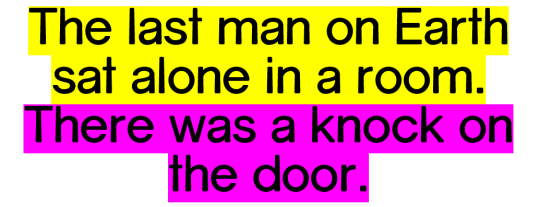
Enjoy creative writing? Think you could do better than the two-sentence story above? Then enter the English Faculty’s Two Sentence Story Competition. We’ve got a load of exciting prizes to give away to our lucky winners.
There’s only one rule: your story must contain only two sentences.
To enter, submit your story here by Friday 30th September.
Good luck!
A Level Language students: want to see a top grade exemplar for Section A of the Year 12 exam?

Your wish is our command.
Hannah Franks and Abbi Lowden have kindly allowed us to share their exam papers so that you can see what makes an A grade response to the Year 12 exam.
Below, you’ll find the paper, the mark scheme, and two A grade responses to it.
We hope it’s useful.
A Level English Language Exam – Year 12 – June 2016
A Level English Language Exam – Textual Analysis Mark Schemes
A Grade Exemplar – Section A (Textual Variations and Representations) 1
A Grade Exemplar – Section A (Textual Variations and Representations) 2
Incoming Year 8s and 9s: your holiday homework is here!

The summer holidays are not just a time for relaxing and watching the horizon scroll by; they’re also a time for taking risks and challenging yourself. We’d like you to use some of your holiday reading great books.
Your Tasks
- We’d like you to take home your Library Lesson Reading Booklet and complete the final tasks on A Christmas Carol
- We’d like you to aim to read at least four books (preferably more!) over the holiday.
Our Advice
- Double check that the books are on the Accelerated Reader system before getting stuck in. (You can, of course, read books that aren’t on the system – but you won’t be able to get points for these.)
- Try to pick books that fit within your Accelerated Reader ZPD range. You can find this by logging in to AR and checking the Progress tab.
- If you are struggling to find a book then don’t forget you can access our virtual library.
If you have any trouble logging in to AR, you can contact Mr Smith by email over the holiday: m.smith@lutterworthcollege.com.
Enjoy the break!
Summer homework for incoming Year 11s

Going to be in Year 11 in August?
Then this post is for you!
Before your first lesson back after the summer holiday, you need to have completed the following tasks. Bring your completed work with you to your first English lesson.
1. Complete the revision tests on An Inspector Calls and The Sign of Four.
They are both 75 questions long, and test your knowledge of each text’s story and key quotations.
(Note: you cannot save your progress in either test, so make sure you set aside plenty of time to complete them.)
When you’ve submitted your answers, you will be emailed your results. (Make sure you enter your email address very carefully as a mistake will result in your score not being recorded.)
The pass mark for each test is 80%. If you fail to achieve this mark, you’ll need to do some revision of the text before having another go.
Make sure you print off your results emails to show to your English teacher. (If you don’t have a printer, you’ll need to print the emails off at school when you come back.)
You’ll find the links to the tests below:
An Inspector Calls revision test
The Sign of Four revision test
2. Find definitions for the Top 40 Poetic Terms you’ll find below.
You can present these definitions however works best for you.
A sample definition for you to give you the idea of what we’re after:
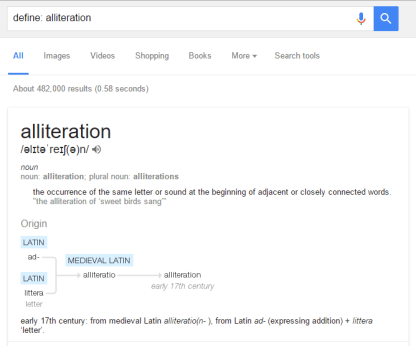
- Alliteration: When words that are close together start with the same sound. For example, Two wrongs don’t make a right.
If you get stuck, we recommend that you:
- Check the glossary at the back of the CGP Love and Relationships Poetry Guide many of you have already bought from the library. (It’s available online here.)
- Search for the term online. (On Google, typing ‘define [term]’ will give you an accessible definition, as below.)

If you have any questions about any of this work, you can get in touch with us on Twitter, or by email (m.smith@lutterworthcollege.com).
Enjoy the holidays!
The English Faculty
Year 10: Want to see some Grade 8 Writing with a Viewpoint work?

Look no further.
A couple of weeks ago, you all sat the following assessment:
‘Young people spend far too much time on social networks. It’s damaging their education, endangering their safety and destroying their ability to communicate.’
Write a letter to a broadsheet newspaper in which you explain your point of view on this statement.
Below, you’ll find two exceptionally strong responses to that task.
See if you can work out why they achieved such high marks:
A Level English Literature: Summer Work for Incoming Year 13

Studying A Level English Literature in Year 13 next year? Here’s your summer work! Please read the instructions carefully as ALL THREE SECTIONS ARE EQUALLY IMPORTANT
1. Summer Reading for NEA
In preparation for your NEA, which accounts for 20% of your A level grade, you need to purchase and read The Bloody Chamber by Angela Carter.
An information sheet on the NEA can be found HERE. As you read the collection we’d like you to consider the themes below as these will form the basis of your NEA
- minds under stress
- the Gothic
- representations of women
You may wish to choose a theme not featured on the list; this will need to be approved by Mr Smith.
We’d also like you to consider reading as any texts from the pre 1900 list below which you think would make an interesting comparison to The Bloody Chamber.
- Jane Austin – Northanger Abbey
- Wilkie Collins – The Woman In White
- Henrik Ibsen – A Dolls House
- Mary Shelley – Frankenstein
- Bram Stoker – Dracula
- The Castle of Otranto
- Wuthering Heights – Charlotte Bronte
You may wish to choose a text not featured on the list; this will need to be approved by Mr Smith.
You must bring this book with you when you start back after the holiday.
2. NEA Proposal: Research and critical reading
You should produce some detailed research on The Bloody Chamber and the three possible areas of study:
A good starting point is eMagazine, use the search function to find articles on The Bloody Chamber
(To log in, you’ll need the details you’ll find by clicking on the ’emagazine’ tab at the top of this page.)
I also recommend that you use the British Library site, this has a whole section dedicated to Angela Carter and The Bloody Chamber
The British Library on Angela Carter
You must bring these notes with you when you start back after the holiday.
3. Summer Reading
In preparation for for the year 13 Texts Through Time module you need to purchase and read the following 3 texts
______________________________________
If you have any questions about any of the summer work, contact Mr Smith (m.smith@lutterworthcollege.com).
Enjoy your holiday!