
Category: GCSE English Language
Our Top Tips for the Year 11 Mock Exams

Excited about your forthcoming English mock exams, Year 11?
If the answer is no, we understand. But practice will make perfect – and we want you to have had as much of that as possible in advance of the real examinations in May/June.
The top tips you’ll find below are designed to help you to prepare for the Language mock exams on Wednesday 23rd March, and the Literature mock exam on Monday 11th April. We hope they’re useful!

You should be old hands at the Language exams by now, as you sat mocks in both in November last year. You’ve also been doing regular Unit 2 (Writing) tasks in class over the past couple of months.
You may be less familiar with the Literature paper you’re sitting. This is where this very blog comes in handy!
At the top of this page, you’ll see a link to Past Papers.

Here, you’ll find a load of past papers for both Language and Literature. Have a look at them. Get a feel for the types of question that tend to come up. (Remember that you’ll be doing the Unit 1 Literature paper for your mock on the 11th April.)
You’ll also notice a link to our revision guides:

Each of these is just a few pages long, but they contain all the key info you need: advice on timings, examiners’ hints, dos and don’ts and lots more. Use them!

Preparation is critical to doing your best. That’s the reason this quote is popular in schools!
So what can you do to prepare?
Quite a lot, actually!
Many people think it’s impossible to revise for the English Language exams. They’re wrong.
Here are just a few of the things you could be doing to revise for them:
- Use ActiveTeach to revise (a) how to approach the different types of Unit 1 (Reading) paper question and (b) how to write the various different types of text you could be given for Unit 2 (Writing).
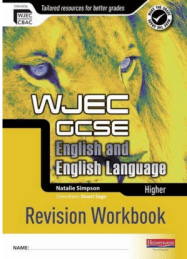
- Use your WJEC GCSE English Language Revision Workbook. (If you haven’t got one, you can pick one up from the library at the discounted price of £5.50.)
- Have a go at a past paper and get your English teacher to have a look at it.
- Complete some of the tests you’ll find here to practise your spelling, punctuation and grammar.
- Read some of the exemplar pieces of writing we’ve posted on the blog. (Search for ‘exemplar’ and you’ll find plenty of student work.)
- Re-read the examiners’ report we put together after your last mock exams – and avoid the common mistakes it mentions.
- Get reading. The best writers are the ones that read voraciously. You can find a selection of great ‘quick reads’ on our blog here.
Revising for the Literature exam is, perhaps, a little easier. Here are our recommendations:
- Re-read Of Mice and Men. If you’re short on time, there’s a 20-minute version in our Of Mice and Men Revision Folder – where you’ll also find a ton of useful revision material.
- Download some of our revision audio files for use on-the-go. (For the password, ask your English teacher or email Mr Shovlin – s.shovlin@lc.leics.sch.uk – who’ll send it to you.)
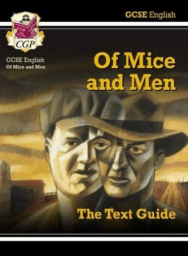
- Use your CGP revision guide. (If you don’t yet have one, they’re on sale in the library for £3 – half price!)
- Learn the key quotes from the novel, as you won’t be allowed a copy of the text in the exam. (You can play games with this set, and even import them into the free Quizlet app on your phone.)
- Familiarise yourself with the unseen poetry section of the exam by looking at the past Unit 1 Literature papers, and by having a go at the pairings in the revision guide.
- Sign up for our Easter Exam Masterclass on the Literature papers if you haven’t already done so.

The mock exams are designed to help you to get your head around the exams. We’re not trying to catch you out.
If you do mess up a mock exam, it’s not the end of the world. It’s far better to make mistakes in a mock exam than in the real thing!
Good luck!

Year 10 Revision Guides
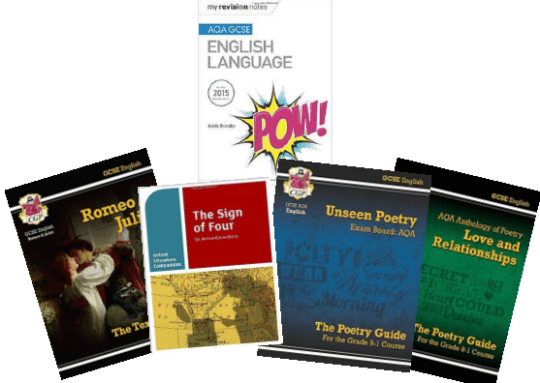
These are now available from the library, all with at least 25% off the retail price.
More details on the letter you’ll find below.
If you’ve any questions, get in touch with Mr Shovlin (s.shovlin@lc.leics.sch.uk).
Year 11 Easter Exam Masterclasses

Year 11!
Thinking about your Easter revision schedule?
Fancy getting some advice from the very people that mark your exam papers?
You’ve come to the right place!
We’re running 90-minute Exam Masterclasses in the Easter holiday, and these will be led by two experienced WJEC examiners.
There are two sessions you can sign up for:
- GCSE English Language Exam Masterclass
- GCSE English Literature Exam Masterclass
Both sessions will run three times each on Thursday 7th April.
Session times are as follows:
Session 1: 9.00am to 10.30am.
Session 2: 11.00am to 12.30pm
Session 3: 1.00pm to 2.30pm
To book your spot, you’ll need to use the online booking system here. Each session costs £5, and you’ll need to use Parent Pay. Places are first come, first served – so be quick!
The final deadline for bookings is 16th March.
Any questions? Ask Mr Shovlin in L1A or email him on s.shovlin@lc.leics.sch.uk.
It’s time for the Ultimate Grammar Police Exam!

Only applicants who achieve full marks on their first attempt will be promoted.
Take your time!
The deadline: Monday 11th April.
Fancy seeing an A* informal letter?

Look no further. Thanks to one of our Year 11 students for letting us share this; we’ve removed the address for obvious reasons.
Fronting and embedding

Looking for a quick and easy way to vary your sentence structuring to (a) improve your writing and (b) increase your marks?
Look no further!
First things first
You need to understand the difference between a main clause and a subordinate clause.
Complex sentences contain main clauses (which can be sentences by themselves) and subordinate clauses (which don’t make sense by themselves).
For example:
You should build a youth facility on the land because it will enhance opportunities for young people in the area.
Here, the main clause is:
You should build a youth facility on the land
This could be a sentence by itself, complete with a capital letter and a full stop.
The subordinate clause is:
because it will enhance opportunities for young people in the area
This can’t be a sentence by itself, as, if we popped a capital letter at the start and a full stop at the end, it would sound ‘unfinished’.
Activity 1: Try to identify the subordinate clauses in the sentences below. (You’ll find the answers after the picture.)
- When you leave, shut the door.
- If you want to kiss me, just ask.
- I wanted to kiss him because he is beautiful.
- I like children, although I couldn’t eat a whole one.

Answers to Activity 1:
- When you leave, shut the door.
- If you want to kiss me, just ask.
- I wanted to kiss him because he is beautiful.
- I like children, although I couldn’t eat a whole one.

Fronting is when we place a subordinate clause (or phrase) at the front of our sentence, like this:
Because it will enhance opportunities for young people in the area, you should build a youth facility on the land.
Activity 2: Rewrite these sentences so that the subordinate clause is fronted.
- I will continue to support the plan even though I disagree with many of your arguments.
- I was disappointed by the result of the action despite expecting it.
- The uniform policy at Lutterworth College is in desperate need of a revamp, although I can see why it was put in place.
- I was excited by the new menu until I saw it first-hand.
Answers are below the image…

Answers to Activity 2:
- Even though I disagree with many of your arguments, I will continue to support the plan.
- Despite expecting it, I was disappointed by the result of the action.
- Although I can see why it was put in place, the uniform policy at Lutterworth College is in desperate need of a revamp.
- Until I saw it first-hand, I was excited by the new menu.

When we embed a subordinate clause or phrase in the middle of a sentence using parenthetic commas, it’s another way of impressing the examiner.
The key thing is that your embedded clause/phrase should be removable without destroying the sentence.
For example:
Vegetarianism, despite people’s misconceptions about it, is a healthier way to live.
If we took out the subordinate clause, we’d have Vegetarianism is a healthier way to live, which makes sense without it.
Activity 3: Embedding subordinate clauses/phrases into main clauses.
Below, you’ll find a table of main clauses and subordinate clauses/phrases. See if you can turn them into full sentences with embedded clauses.

Answers are below the next image…

Answers to Activity 3:
- My English lessons, even though they were difficult, were the most inspiring ones I had.
- I saw the new Avengers film, which cost more than $200 million to make, at the Showcase last night.
- My teacher, a diligent and committed man, kept an eye on my progress.
- The best album of all time, Girls Aloud’s ‘Tangled Up’, was released in 2007.
Think you’ve got it? Click here to take a cheeky little test that will email you your results.
Using ActiveTeach on the VLE

Year 11! Want to get the useful English Language stuff on the VLE?
This guide will tell you everything you need to know.
Want to read a couple of A* reviews?

Here’s are a couple of brilliant bits of Unit 2 review writing from a couple of our very own Year 11 students.
Both reviews are aimed at students in Year 11.
See what you think!
A-star Review Exemplar – ASAP Rocky.pdf
A-star Review Exemplar – Alvin and the Chipmunks – The Road Chip.pdf
Describing a supermarket

Just before Christmas, all of our Year 10 students had a go at writing a description inspired by the picture above.
You can find a selection of brilliant descriptive writing in the comments on this post.
If you’d like to add some of your own, feel free.
Other students can then use it for inspiration for future descriptive tasks.
Year 11 Mock Exams – Examiners’ Report

The majority of you did well on your Year 11 mock exams, but this report focuses on what could be improved in advance of the second set of English mocks in March.
Unit 1: Reading
- Make sure you stick to 15 minutes per question; Question 4 had the lowest average mark for this paper, which is possibly down to you running out of time.
- Refer to writers by their last names. You’re not friends with them.
- Start each question on a new side in the answer booklet. This makes it easier for an examiner to mark, and easier for you add extra content to in the event that you have some spare time.
- Try to begin each answer with a topic sentence that shows you’ve understood the question.
- Back up all of your points with quotations from the texts.
- Use the language of the question in your answer to ensure you stay focused on what’s being asked of you.
- Do what the question tells you to do. If you’re asked to divide an answer into two sections, do it.
Unit 2: Writing
Content
- Take your time working out what you are being asked to do and make sure you’re doing it!
- The letter, for example, ought to have been addressed to a local newspaper, and yet around ¼ of you aimed it at the local council. Similarly, some of you thought it was the newspaper planning on running a festival. Read the task carefully.
- A ‘lively’ article should be entertaining, and not dull. Many of you wrote articles on social networking that felt more like advisory leaflets.
- Think carefully about your audience. The article, for instance, was aimed at students your age, and so the best responses were a little more casual and entertaining.
- Adopt the right form for your text. Letters need addresses – and these need to be in the right place. Articles need headlines and bylines, and these should be engaging – not dull.
- Plan your pieces of writing and include these plans in your answer booklet so that the examiner can see you’ve given your work some thought. Well-planned pieces almost always achieve higher marks.
- A strong set of arguments is always preferable to simply crowbarring in the persuasive devices.
Sentence structure, punctuation and spelling
- Basic errors meant that the average mark out of 7 was for SPPS was under 3.
- There is no excuse for failing to start sentences/proper nouns with capital letters.
- Commas should not be used to separate sentences.
- Apostrophes should be used when necessary and avoided when not.
- To access the higher marks for SSPS, you should be:
- Using a range of punctuation (beyond full stops, commas and apostrophes) accurately and for effect.
- Varying your sentence functions and types for impact on the reader.
 English at Lutterworth College