
Category: Uncategorized
English A Team: Year 11
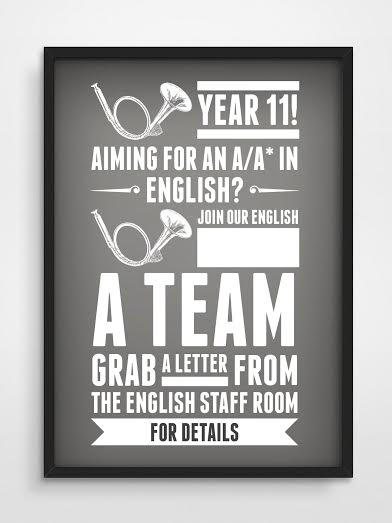
You can find a copy of the letter at the bottom of this post. Return it to the English Staff Room ASAP if you’d like to join.
Our first session is on Tuesday 15th December. Details below, and you can sign up outside the English Staff Room. Be quick: places are first come, first served.
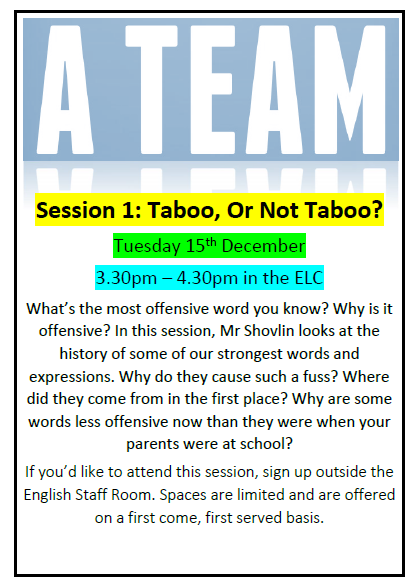
Any questions? Get in touch with Miss Kirkpatrick or Miss Marvin; their contact details can be found by clicking on the Contact your teachers tab at the top of this page.
The Grammar Police Entrance Exam Results
We had more than 650 applicants wanting to join the Grammar Police; fewer than a hundred met our exacting standards.
The lucky few will receive their certificates this week.
Here is Mr Solly – one of our successful applicants – with his gold certificate.
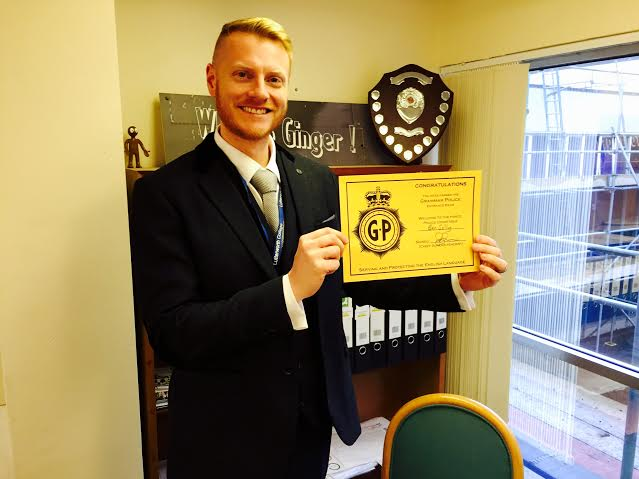
If you didn’t achieve 10/10, don’t be deterred; applications will open again later in the year.
You can see the results for the exam below. (Click on the image to enlarge it.)
For explanations of the more tricky questions, scroll down.
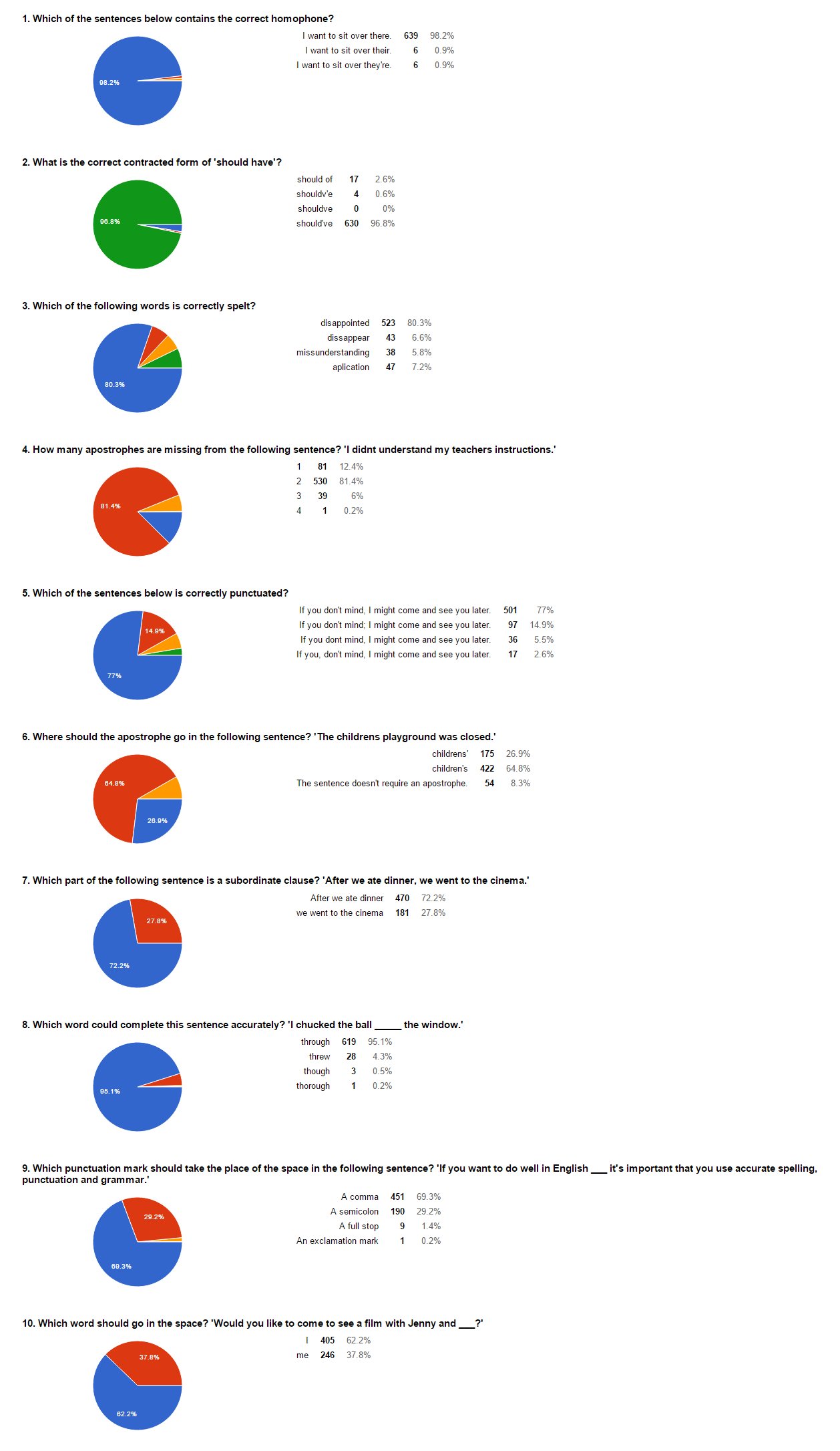
Questions 6, 7 and 9 tripped up many of our applicants.
For Q6, you were required to place the apostrophe between the n and the s in children’s. Apostrophes of ownership/possession can cause much confusion. You might find this helpful.
A simple rule: find the owner(s), add the apostrophe, and add an s if there isn’t one there already.
In this case, the owner(s) = the children – and so the apostrophe follows the n. We have to add an s as ‘children’ doesn’t end with one.
(If it were a ladies’ section in a clothing shop, the apostrophe would follow the s, as the owner(s) = the ladies.)
For Q7, you needed to identify the subordinate clause. Don’t forget that a subordinate clause cannot be a sentence on its own, whereas a main clause can.
For Q9, the answer was a comma, as you need a punctuation mark that could separate a subordinate clause from a main one. A semicolon would not be appropriate here, as they are used to separate main clauses. More information on semicolons can be found here.
The only question more students got wrong than right was Q10. When thinking about whether to use I or me in a sentence, a quick and easy rule is this: use the word you’d pick if the other person were removed from the sentence.
Take our example, Would you like to come and see a film with Jenny and ___. If we remove Jenny from the sentence, our options are:
Would you like to come and see a film with I?
and
Would you like to come and see a film with me?
Clearly, the second one is the one that sounds ‘right’.
This video, from Oxford Dictionaries, helps to explain why this is.
Thanks again to all of our applicants.
Chief Superintendent Shovlin
The register of recipes

Year 12 Language students: if you can prise your eyes from the beautiful Jamie Oliver, you may find the following bits and bobs useful when writing your essay on the three recipes we’ve studied in class.
- The exemplar essay attached below should give you an idea of the appropriate length/style – though it’s by no means perfect.
- Use the mark scheme to focus your attention on what is required of each level.
- Use the other sheets to ensure your work is correctly formatted and that you use quotations accurately and effectively.
Deadline details and hand-in information can be found on SMHW.
Any questions? Ask!
Recipes Essay Mark Scheme.docx
Dont you hate it when people misuse apostrophe’s?

So, a few years ago, Waterstone’s decided to get rid of its possessive apostrophe in order to become Waterstones. According to an article in The Telegraph, the decision provoked ‘outrage’. Outrage along the lines of this:

and, my personal favourite, this: 
Waterstone’s (or rather, Waterstones) justified the decision by saying the apostrophe-free spelling is more ‘versatile’ and suited to modern URLs. Here’s The Telegraph on the subject, and you can find a smart article from The Guardian here.

The Kill The Apostrophe campaign puts forward a rather convincing argument here. The Apostrophe Protection Society make a similarly persuasive case here. A couple of items in The Telegraph: one on a council abolishing apostrophes on its signs; the other by Christopher Howse arguing that we perhaps take it a little too seriously.
You may have noticed Land’s End (or is it Lands’ End? Or Lands End?) in the news recently after Cornwall Council decided it needed its apostrophe after all.
No language debate would be complete without a contribution from our resident deity Mr Crystal, debating apostrophes with none other than Paxo on Newsnight…
And here’s Crystal again on the Waterstones/Waterstone’s furore. And let’s not forget you can’t go wrong with a bit of Lynne Truss, who explores the history and current use of the apostrophe in the first episode of her Cutting a Dash series, which you can listen to below:
At the bottom of this post, you’ll find Dr Julia Gillen in an article taken (surprisingly enough) from The Sun, as well as a perceptive and well-informed article from eMagazine.
When you’ve had a look at all of the texts to which I’ve linked, I’d like you to to answer the following question in the comments sections of this post: Should we abolish the apostrophe?
Guidance:
- You should aim to write 200-300 words, and support your point of view with careful argument.
- You should make reference to the arguments presented in the clips/texts linked to in this post.
- Oh, and if you’re still struggling with apostrophe usage yourself, you could do a lot worse than this site to brush up. After all, Crystal may not judge you – but I certainly will.
Mr Shovlin
Are YOU fit for the force?
Clicking on the Grammar Police logo above will take you to the entrance exam.
Take your time. There are only 10 questions, but one mistake will cost you your place on the force – and your chance at winning a £10 bonus!
Good luck!
 English at Lutterworth College