The Eggcellent Easter Revision Timetable

Year 11! You asked for it (well, you didn’t) – and here it is.

A day-by-day plan for revising for your English Literature GCSE, with plenty of activities to help prepare you for both the real final literature exams, which are all too soon.

The Eggcellent Easter Revision Timetable for GCSE English Literature 2019
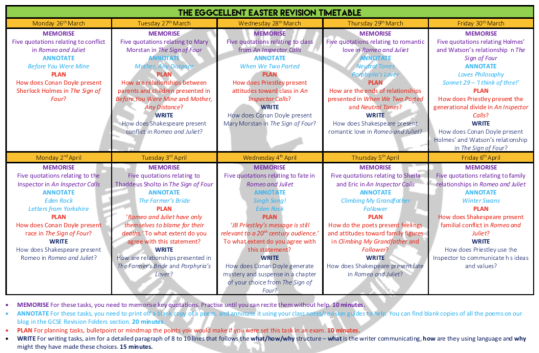
Screenshot 2019-04-08 at 20.59.58

(Click on the hyperlink above for a higher resolution version.)

If you’re aiming for a grade 9, why not check out this amazing blog with example essays for everything as well as these cheeky essays on every poem!

You can find our GCSE Language Revision Folders by clicking on the link at the top of this page. Don’t forget all of the useful audio you’ll find too by clicking on GCSE Playlists. You should know the password. If not: email Mr Smith (m.smith@lutterworthcollege.com).

Enjoy!

Sapere Aude – March Issue

Another brilliant issue of our student-run magazine, Sapere Aude, is out.

Sapere Aude

Click on the link below to read it.

Sapere Aude – Issue 2 – March 2019

Massive thanks to all of the students involved, and to Mrs Downie for overseeing them. The next issue will be out in the summer term. If you’ve got any suggestions for content, please email our editor, Eleanor Pilkington: e.pilkington08@lutterworthcollege.com.


Year 11 Language Paper 2 PPE: Examiners’ report

1

This year, all of you have sat a full English Language Paper 2 for your December PPE.  The aim here is to have a look at key issues that cropped up on this paper so that you can do better in the summer exams than in your December ones. You’d be wise to make notes on the advice given below – it’ll help you prepare for the real exams which are not that far away now!

Section A: Reading

  • You must read the questions carefully. A significant number of you lost marks in Question 2 because you didn’t answer the question. It asked you to summarise the things to see and do at the festivals. Too many people wrote about the weather and other aspects of the text.  The examiner wants to give you marks. Don’t put obstacles in the way of them doing that!
  • Refer to writers by their last names and it’s okay to refer to ‘the writer’ instead.
  • If you are asked about a writer’s use of language, make sure you use correct technical terms and the effect the language has on the reader. Many of you lost marks on Question 3 by quoting without explaining. Remember: WHAT-HOW-WHY.
  • When you are asked to compare, make sure you compare. In Question 4, you need to comment on differences between the two texts (you can also mention similarities IF there are any).  Many of you lost marks by not writing about the differences between the texts.
  • Use the language of the question in your answer to ensure you stay focused on what’s being asked of you.
  • Try to begin each answer with a topic sentence that shows you’ve understood the question. For instance, for Q3 (How does Dickens use language to make you, the reader, feel part of the fair?) a smart way to start would be something like: Dickens’ use of the pronoun ‘you’ brings the reader straight into the fair.

Section B: Writing

Content and Organisation

  • Take your time working outwhat you are being asked to do and make sure you’re doing it! Students who misjudged the audience, purpose or format of a task invariably lost a lot of marks.
  • Plan your writing. You should spend approximately 10 minutes of the 45 minutes allowed for this task on your plan.  Plan WHAT you will say and HOW you will say it.
  • Include these plans in your answer booklet so that the examiner can see you’ve given your work some thought. Well-planned pieces almost always achieve higher marks, and examiners are disheartened when they don’t see a plan at the start of a piece of writing.
  • A strong set of arguments is just as important as using a range of persuasive devices.Students who’ve given their argument some thought have more to say, and say it more convincingly.
  • USE PARAGRAPHS!
  • If you’re writing to a newspaper, begin with To the Editor, orDear Editor, or create a name for them. You should not be writing Dear Newspaper or To whom it may concern – or, worse – Dear to whom it may concern!
  • You need to know how to lay out a formal letter – and how it’s different from an informal letter. Errors in laying out a text will have a real impact on your mark.
  • Making up silly addresses – e.g. 10 Street St, McStreetville, Streetshire– is not going to impress an examiner.

Technical Accuracy

  • A number of you are still making basic errors that limit your SPaG.
  • There isno excuse for failing to start sentences/proper nouns with capital letters.
  • Commas should notbe used to separate sentences.
  • Apostrophes should be used when necessary and avoided when not.
  • To access the higher marks for Technical Accuracy, you should be:
    • Using a range of punctuation (beyond full stops, commas and apostrophes) accurately and for effect – e.g. semicolons, colons, brackets, ellipses.
    • Varying your sentence functions and types for impact on the reader.
    • Showing that you have a good vocabulary.


To improve your skills, use study guides (some are available from the library).


We hope this report helps a little.


You know where we are if you have any questions!

Year 11 Mock Exams: Examiners’ Report Paper 1 Summer 2018

Image result for marking red pen

Right then, Year 11. First things first: congratulations on having sat your first GCSE Language mock exam. It was a big ask, and the majority of you rose to the occasion – so well done.

In this examiners’ report, we’ll be focusing on each question in turn, focusing on what you’d need to do to improve.

First things first

You should have been given a Mock Exam Attainment Tracker by your English teacher on which to record your marks for each question and each paper.

For each question, the number of rows corresponds to the number of marks available for that question. The width of the column relates to how much that question contributes to the overall mark for the paper. So, for instance, the columns for Q1 on both papers are half the width of the columns for Q2 – as both Q1s are worth 4 marks, whereas both Q2s are worth 8.

When you’ve shaded in these tables to reflect the marks you achieved for each question, you will be able to see where you did particularly well, and where there’s room for improvement.

Let’s take a sample student’s tracker for Paper 1.

tracker

As you can see, they scored 3/4 for Q1, 5/8 for Q2, 5/8 for Q3 and 8/20 for Q4 on the reading side of the paper. This gave them a total of 21/40 for the reading.

For the writing question, Q5, they got 16/24 for AO5 and 11/16 for AO6 – giving them a total of 27/40.

Their overall score of 48/80 would give them a grade 4 – but the student is only 2 marks away from getting a grade 5. Which question do you think they need to focus on the most?

We’d argue it’s Q4. The student is clearly bright, as they managed to get more than half marks for every other question – and yet they’ve dipped significantly on Q4.

If they’d achieved the same level for Q4 as they did Qs 2 and 3, the student would have achieved an extra 4 or 5 marks – which would have put them close to the boundary for a grade 6!

You should be using these trackers with your English teachers to identify where you need to focus your efforts when it comes to your next steps.

Image result for pile of exam papers

The Grade Boundaries

For both of your mock exams, we set the following grade boundaries:

grade-boundaries


General Feedback

  • Students tended to achieve higher marks on the writing than on the reading.
  • Q4 was the lowest-scoring question on both papers.
  • Timing was an issue – with a significant number of students running out of time and having to rush the writing section, or skip reading questions in order to get to it before time ran out.

Priorities

  • If you don’t yet have a copy of the My Revision Notes revision guide, you are missing out on some invaluable advice. It’s available from the library for just £6, and has activities, advice and hints for both English Language papers.
  • Listen to the feedback your teacher has given you. It’s likely they will have pointed out the areas you ought to be focusing on – and you’ll find Next Steps for each of the questions further on in this post. The more hard work you put in now, the better the position you’ll be in for the real thing next year.

Image result for red biros

Paper 1: Explorations in creative reading and writing

Click on the links below for:

Paper 1 Question 1

Despite being a fairly straightforward question, several of you lost marks on this question as you:

  • Forgot to write in sentences – e.g. ‘Inky fingers’ rather than He had ‘inky fingers’.
  • Didn’t read the question, which asked you to focus on Hale, and not Brighton.

Suggested Next Steps:

Paper 1 Question 2

For this 8-mark question, you were given a short extract from the text to focus on, and you were asked to comment on the writer’s choice of: word and phrases, language features and techniques, and sentence forms.

Students who underperformed on this question did so because:

  • They didn’t comment on all three of the bulletpoints.
  • They were a little too vague in the comments they were making – e.g. The writer uses this word to get the reader’s attention.
  • They forgot to comment on the impact of the language features on the reader.

Suggested Next Steps:

  • Read pages 14 – 19 of your My Revision Notes revision guides, and complete the activities.
  • Work through this PowerPoint.
  • Download and print this grammar glossary so that you have a range of technical terms at your disposal for analysing texts.
  • After you’ve done the above things, redo the question at home, and get your English teacher to see if you’ve improved.

Paper 1 Question 3

For this 8-mark question, you needed to comment on how the writer of the extract had structured it to interest you as a reader.

Common reasons for underperformance:

  • Students didn’t comment explicitly on structure – i.e. why the text is in the order it’s in, and how the focus of the text shifts as it progresses.
  • Students failed to use terms associated with structure – e.g. perspective, focus, zooms in.

Suggested Next Steps:

  • Take a look at this Level 3 answer (6 out of 8 marks) that has been annotated by an examiner to show why it’s achieved that mark.
  • Scroll through to the second answer in this document, as it achieved Level 4 (8 out of 8 marks). It’s also annotated to show how and why it’s achieved full marks. Read it carefully and make notes on why it’s successful.
  • Read pages 20 – 25 of your My Revision Notes revision guides, and complete the activities. (You’re welcome to bring any work you’d like looking at to our GCSE English Drop-In sessions, which run every Tuesday lunchtime in L1A.)
  • Work through this PowerPoint.
  • After you’ve done the above things, redo the question at home, and get your English teacher to see if you’ve improved.

Paper 1 Question 4

This 20-mark question was one that many students struggled with, perhaps due to timing issues, or perhaps because they found it more challenging than the other questions.

For this question, you were given a statement about the text, and were asked to what extent you agreed with it.

Common issues that arose:

  • Students contradicted the statement. Remember: the statement given to you by the exam board will always be a reasonable interpretation of the text, and will have been given to help direct your answer.
  • Students drifted away from the focus of the question, and started writing about aspects of the text that didn’t relate to it.
  • Students didn’t leave enough time for this question – even though, at 20 marks, it was worth the same amount of marks as questions 1, 2 and 3 combined.

Suggested Next Steps:

  • Read through this Level 3 answer (16 out of 20 marks) and pay attention to the examiner’s comments justifying the mark.
  • Scroll to the second answer in this booklet, as it achieved Level 4, and got full marks (20 out of 20). The examiner’s comments tell you why it achieved that mark. Make a note of these reasons.
  • Read pages 26 – 34 of your My Revision Notes revision guides, and complete the activities. (You’re welcome to bring any work you’d like looking at to our GCSE English Drop-In sessions, which run every Tuesday lunchtime in L1A.)
  • Work through this PowerPoint.
  • After you’ve done the above things, redo the question at home, and get your English teacher to see if you’ve improved.

Paper 1 Question 5

This was the writing task, and you were given a choice of two tasks: a description inspired by a picture of a beach, or a description of an occasion when you felt unsure or challenged.

Picture.png

Common issues we found:

  • Students had run out of time by Q5, and so rushed their writing. Remember: Q5 is worth 40 marks – which is the same as all 4 reading questions put together! You must make sure you leave 45 minutes for it.
  • A lot of you wrote narratives despite the key word in both tasks being Describe. Remember: in the exam next summer, you may be given a choice of two narrative tasks, a choice of two descriptive tasks, or a choice between a narrative and a descriptive task. Make sure you’re doing what’s asked of you.
  • Technical accuracy was an issue for many students, despite AO6 being worth 16 marks. You must make sure you’re leaving time to check your work, and to make any corrections.

Suggested Next Steps

  • Take a look at the Level 4 response you’ll find here – it achieved 38/40 marks, and is thoroughly annotated with what the student has done well.
  • Have a look at the second answer in this booklet, and decide if you think it deserves the same mark as the one above, or lower/higher. Your English teacher will be able to tell you if you’re correct!
  • Find out how to avoid comma splicing by clicking here and reading our guide. You can then take the test to make sure you’ve got it sussed.
  • Revise apostrophes using your CGP SPaG workbooks at home, and then take the test you’ll find here to make sure you’ve nailed it.
  • Learn a good way to vary your sentences by clicking here and reading our guide to fronting and embedding. There’s a test to check if you’ve understood.
  • Read pages 76 – 85 of your My Revision Notes revision guides, and complete the activities. (You’re welcome to bring any work you’d like looking at to our GCSE English Drop-In sessions, which run every Tuesday lunchtime in L1A.)
  • Have another go at the question, and ask your teacher to check to see if you’ve improved.


3571102858_2e511c605f_o